
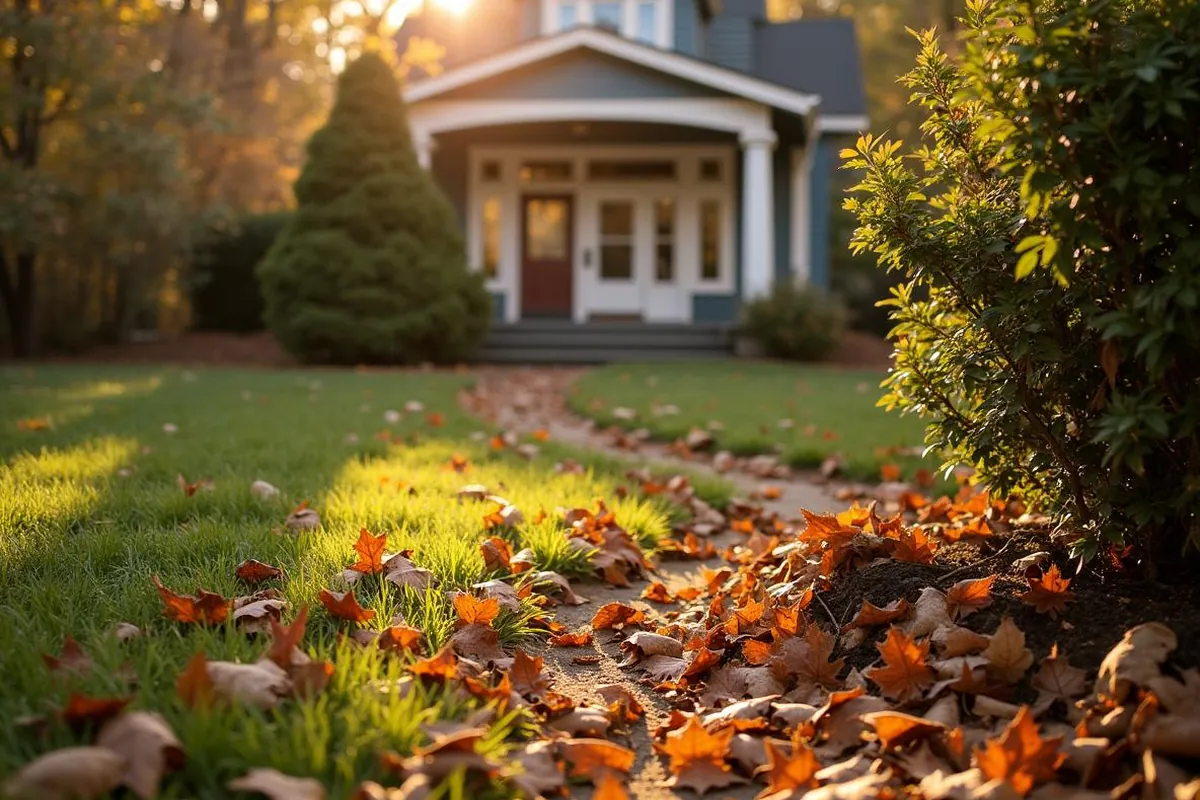
The Louisville East End is not New England. Our winters are mild by any national standard — a handful of snowfalls, a few genuine cold snaps, occasional ice, and long stretches of dry, brown grass. But the yards that come back healthiest in spring are the ones that got prepped correctly in the fall.
Here's the checklist we work through with our East End clients every October and November.
1. The last mow of the year
The final cut of the season is usually in mid-to-late November for Louisville lawns — after growth has fully stopped but before deep cold sets in. That last cut is intentionally shorter than the summer height: about 3 inches for fescue lawns, versus the 3.5–4 inch summer target.
Shorter grass through winter reduces the risk of snow mold, matting, and vole damage under any prolonged snow cover. It also makes the transition into spring cleaner.
If you skip the last mow and let the grass go long into winter, spring starts with a lawn that looks bad and takes an extra month to recover.
2. Leaf cleanup — really finished, not "mostly done"
The single biggest fall mistake we see on new client properties is half-finished leaf cleanup. A single mid-October pass isn't enough when you have oaks, maples, and hickories in the yard. Oaks especially can still be dropping in December.
Wet leaves that sit through winter:
- Smother grass — the lawn under a leaf mat comes back weak and patchy in spring.
- Hold moisture against the foundation and against foundation shrubs.
- Attract voles that tunnel under snow and damage the lawn.
The right approach is multiple cleanups through the fall — usually two to four depending on your canopy. If you can only do one, do it in late November, after the last major drop.
We offer both scheduled rotations and one-time cleanups — see the leaf cleanup service.
3. Landscape bed prep
Beds should be cleaned of dead perennial stems, weeded one last time, and mulched to a good winter depth (about 2–3 inches). Fresh mulch in November does three things:
- Insulates root zones against freeze-thaw damage.
- Suppresses winter weeds.
- Makes the whole property look intentional going into spring.
For evergreens and shrubs near the foundation, a light watering going into a hard freeze helps — dormant plants still lose moisture through their leaves, and the ones that go into winter drought-stressed are the ones that struggle in March.
4. Cut back what needs cutting back
Most perennials get cut down after they've been killed back by frost — hostas, daylilies, coneflowers, ornamental grasses, etc. Some things (roses, hydrangeas, boxwoods) have specific pruning windows that are NOT fall — check the species before you cut.
Trees are generally best pruned in late winter (February–March), not fall, though dead or hazardous limbs come off any time. If you have a tree that lost a lot of leaves early or has visible dead sections, get it looked at now — see tree service.
5. Book snow removal before the first snowfall
This is the one every year we watch clients wait too long on. Louisville doesn't have New England snow volume, but we do get 3–6 significant snowfalls per winter. The problem: snow removal schedules fill up before winter starts.
If you wait until the first big snow to try to hire someone, everyone is already booked. The residential snow removal companies in Louisville East End typically finalize their route in October and November.
We book winter snow spots on a first-come basis. If you know you'll want snow removal this winter, get on the list in October, not December.
See our snow removal service page for details on how it works.
6. Firewood — order now if you'll want it
If you have a fireplace, wood stove, or fire pit you'll use through winter, order seasoned firewood in September or early October. Once the first real cold snap hits and demand surges, supply tightens and delivery windows stretch.
Buying wood in July or August also gives you time to stack it and let it fully finish seasoning if you're planning ahead for the following winter.
7. Store the equipment properly
If you handle your own mowing:
- Drain fuel from the mower or add stabilizer, per your equipment's instructions.
- Sharpen or replace the blade so spring starts with a sharp cut.
- Clean the deck to prevent rust.
- Cover it or move it to a dry storage spot.
Simple, but the people who skip it are the ones with mowers that don't start in April.
Getting help with any of it
If you'd rather have someone else run the whole fall-to-winter transition on your property, get in touch or call (502) 762-8817.
We handle the last cut, the leaf cleanups (however many your canopy needs), the bed prep, and the winter snow removal — all with the same crew, one phone number.
Serving the Louisville East End: St. Matthews, Windy Hills, Crescent Hill, Indian Hills, Rolling Fields, Anchorage, Prospect, Middletown, Douglass Hills, and the surrounding Louisville East End.